Oklahoma sandstone and Lueders limestone supply most of the flagstone in Fort Worth, TX, and the two behave differently underfoot. They look like alternatives on a sample board and stop being interchangeable the moment you know where the stone is going.
Big Tex Stone has supplied the DFW area with landscape and building stone since 2005. This is a buyer’s guide, written for the person deciding what to put on an order rather than how to lay it.
Related: Lueders Stone in Fort Worth, TX: How to Spec Grade, Cut and Thickness Before You Order
How Do Oklahoma and Lueders Flagstone Differ?
Oklahoma flagstone is a warm-toned, irregular sandstone, while Lueders is a paler, more uniform Texas limestone.
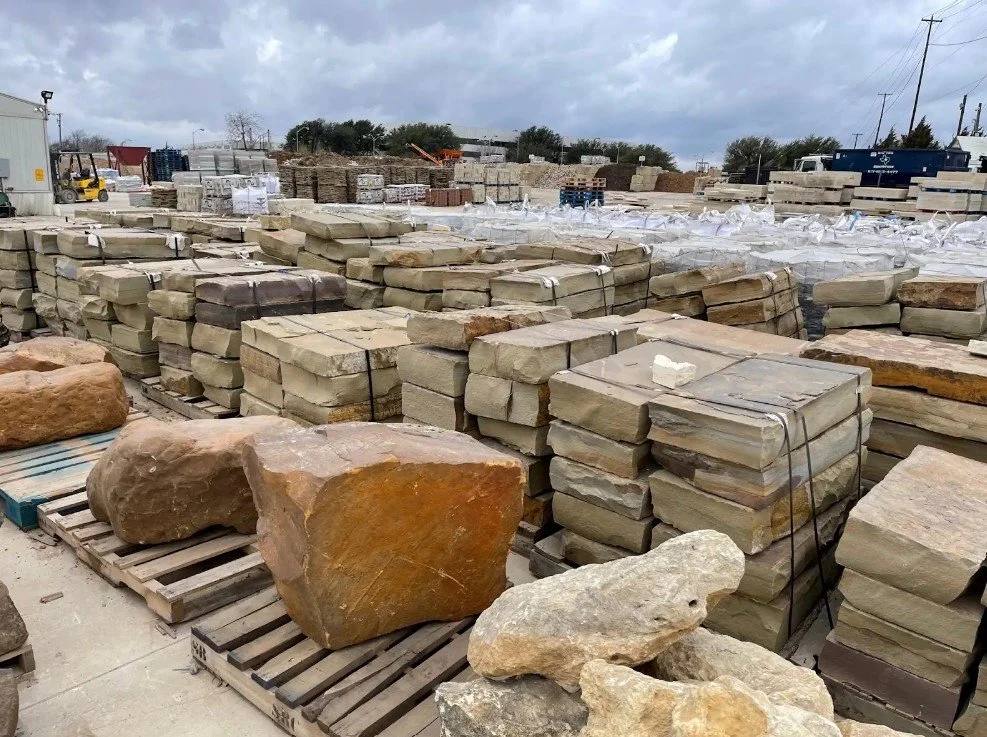
Oklahoma stone shows more variation across a pallet and has a naturally cleft surface, which gives grip and the irregular character people usually picture when they say flagstone. It also needs more fitting on site.
Lueders sets with tighter joints and is also available honed. A honed surface reads as more formal and sits closer to a modern elevation, which is why Lueders tends to win on contemporary builds and lose on rustic ones.
Which Flagstone Thickness Belongs on Which Job?
Flagstone thickness follows what sits beneath the stone. Thinner material is intended to go down in mortar over a concrete slab, where the slab carries the load and the stone is a wearing surface.
Thicker material goes down dry, on a compacted base with a setting bed, because it has to span and resist cracking on its own.
Big Tex Stone stocks Oklahoma flagstone in 1, 1.5 and 2 inch thicknesses and Lueders slabs in 1.25 and 2.25 inch, so the installation method rather than the budget settles the choice.
What Does North Texas Clay Change About Choosing Flagstone?
North Texas clay favors thicker stone on a dry-laid patio, because Blackland Prairie clay swells through a wet spring and shrinks back through a dry August.
Anything laid on it moves, and dry-laid stone absorbs that movement across its joints while a mortared surface concentrates it into cracks.
That movement is also the reason a mortared installation wants a properly built slab beneath it rather than a slab poured thin to save a few yards of concrete.
Related: Why the Right Pool Coping Supply Matters More Than Most Pool Projects Assume
Which Stone Suits Pool Coping and Wet Areas?
Stone around a pool should be chosen for grip when wet and a surface that stays cool, since surface texture and heat matter more than appearance there.
A cleft sandstone keeps its grip when wet, and lighter stone sits cooler underfoot through a Texas August than a dark one does.
Honed stone, often chosen for pool coping, is smoother by definition, so it is worth seeing a wet sample rather than a dry one before ordering. A minute with a wetted piece settles the question.
How Much Flagstone Should You Order?
One ton of standard Oklahoma flagstone typically covers 80 to 100 square feet at normal joint spacing.
Lueders and thicker cuts cover less per ton because each piece weighs more, and a tight, cut-to-fit layout consumes more stone than a loose, irregular one.
Ordering a little over is normal practice, because a second pallet drawn later can come off a different lot and read slightly differently.
Bringing square footage and the intended joint style to the counter gets a closer number than a phone estimate.
Bring Your Flagstone Dimensions to Our Fort Worth Yard
The stone question is quicker to settle standing in front of pallets than scrolling photographs.
Big Tex Stone stocks Oklahoma and Lueders flagstone, building stone, sand and gravel at the yard on Old Hemphill Road in Fort Worth, with pick-up or delivery.
Request a flagstone quote from Big Tex Stone.
In Summary
Can flagstone be ordered by the piece instead of the pallet?
Flagstone is most often ordered by the pallet, which keeps cost down and color consistent within a single lot. Big Tex Stone palletizes its Oklahoma flagstone to reduce waste, so a small repair or a short path is worth discussing with the yard before ordering.
Does flagstone color change once it is installed?
Flagstone color generally deepens when wet and lightens as it dries, so a dry sample in the yard looks paler than the finished patio in rain. Looking at a wetted piece is the most reliable way to judge it.
What is the difference between patio stone and stand-up stone?
Patio stone is selected and sorted for paving, while stand-up stone is thicker and heavier and is generally used vertically or for larger format work. The two are priced and ordered separately.
Related: Flagstone by the Pallet vs Individual Pieces in Fort Worth, TX